Medical Exam vs Food Grade Nitrile Gloves: A Head-to-Head Certification Comparison
Nitrile is the material. Certification is the product. Two gloves can leave the same dipping line with the same powder-free nitrile formulation and still be legally different products — one cleared for patient contact, the other cleared for food contact. The dividing line is not the polymer. It is the standard each glove is tested against, the conformity route the manufacturer has completed, and the intended use declared on the documentation.
This comparison places the two certification profiles side by side using documentation held by Huizhou Anboson Technology Co., Ltd. (ANBOSON): the medical exam stack built on EN 455-1/-2/-3:2020, ISO 10993-5:2009, ISO 10993-10:2021, ASTM D6319-19 and FDA 510(k) K230542, and the food grade stack built on FDA 21 CFR 177.2600, EU food contact materials requirements, Japan MHLW Notification No. 370 and China GB 4806.11-2016. For buyers in the evaluation stage, it functions as a verification checklist rather than a marketing summary.
Problem definition: why ‘nitrile’ is not a compliance answer
Most sourcing errors in this category begin with a naming assumption: that a disposable nitrile glove is simply a disposable nitrile glove. In practice, three independent variables decide whether a glove may be used in a given environment.
- The standard it was tested against. Examination gloves and food contact gloves are evaluated against different standards that answer different risk questions.
- The conformity assessment completed by the manufacturer. A laboratory test report, a notified body certificate and a market authorization are three different documents with three different weights.
- The declared intended use. The application statement on the product file defines where the glove is permitted to be used, not the word ‘nitrile’ on the carton.
A glove that meets food contact requirements has not automatically been evaluated for biocompatibility, so it is not a substitute for an examination glove in a clinical or dental setting. Equally, an examination glove that passes EN 455-3 biological evaluation has not automatically been tested for migration into food under FDA 21 CFR 177.2600, GB 4806.11-2016 or Japan MHLW Notification No. 370. The medical path asks whether the material is cytotoxic or likely to sensitize skin; the food path asks whether substances can migrate from the glove into food.
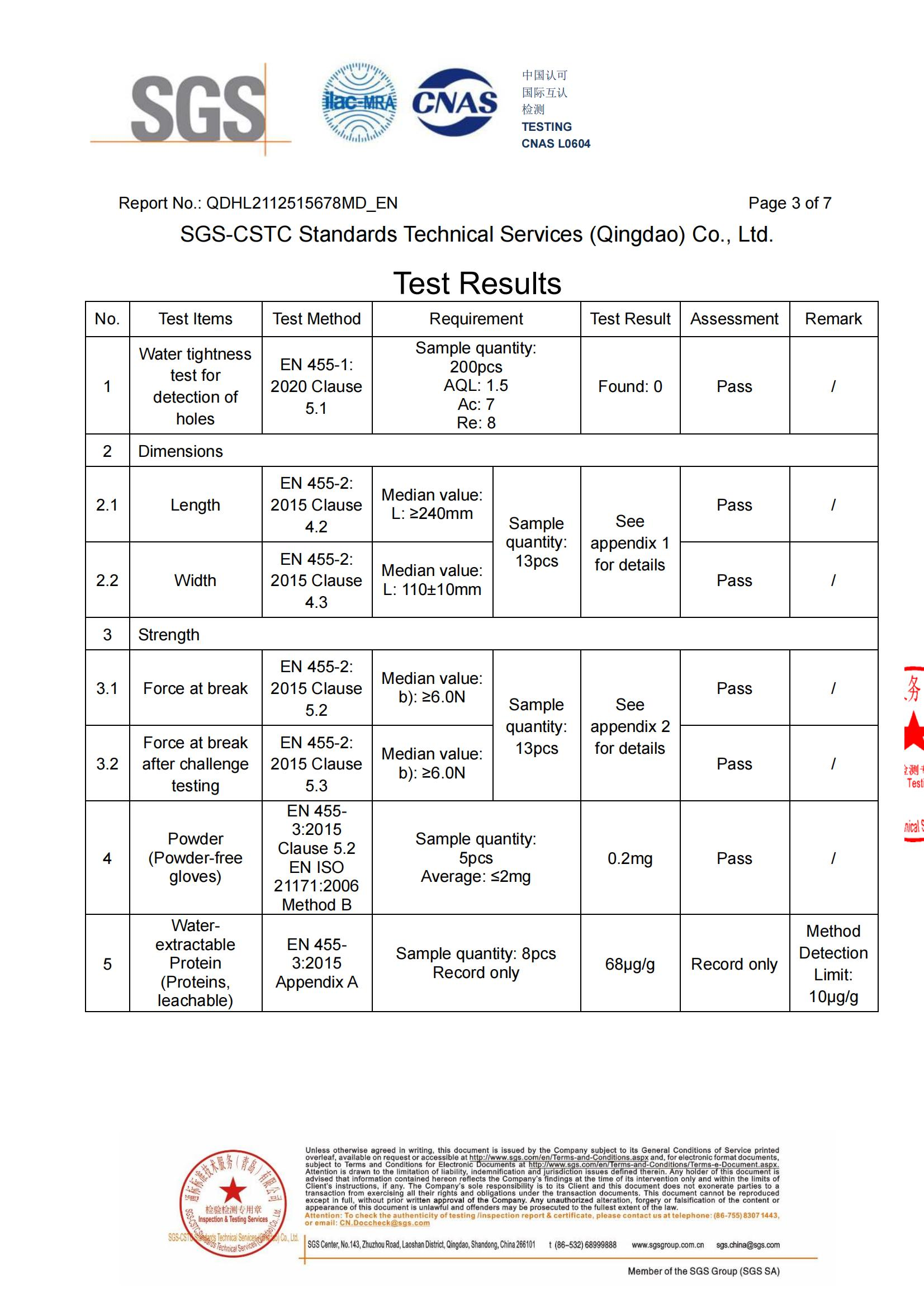
A test report is not a certificate, and a certificate is not a market authorization. ANBOSON holds an EN 455-1/-2/-3:2020 test report from SGS (issued 2022-01-06) as well as a TÜV SÜD PSB test report under the same standard (70.418.24.156.01-00, issued 2024-09-19), alongside a TÜV SÜD PSB certificate (TTCN 113715 0002 Rev.00, issued 2024-10-11). In the United States the equivalent release step is FDA 510(k) clearance, and ANBOSON holds 510(k) K230542 for medical examination gloves. When auditing a supplier, ask for the specific document that maps to the market you sell into — not for ‘certifications’ in general.
Industry background: how the two lines actually sit in a plant
Demand for both categories is concentrated in the same industrial base, which is part of why the confusion is so persistent.
- The global nitrile gloves market was valued at USD 6.5 billion in 2025 and is projected to reach USD 13.2 billion by 2033 (Grand View Research). Other research houses publish materially different totals — Global Market Insights reports USD 31.5 billion for 2024 and IMARC Group reports USD 8.6 billion for 2024 — because the definitions of the category differ. A headline market number should be read as a scope statement, not as a price or capacity signal.
- Powder-free nitrile gloves accounted for 74.8% of global revenue in 2025, dominating the market type segment (Grand View Research). Powder-free construction is therefore a baseline expectation, not a differentiator.
- The medical and healthcare segment held the largest revenue share, 80.1%, of the global nitrile gloves market in 2025 (Grand View Research).
- Medical nitrile examination gloves must comply with ASTM D6319 (US) or EN 455 (EU) standards, typically requiring an AQL of 1.5 (FDA / CEN standards).
- Food grade nitrile gloves must meet FDA 21 CFR 177.2600 in the United States and EU Regulation 10/2011 (EN 1186) for food contact compliance (U.S. eCFR / European Commission).
Huizhou Anboson Technology Co., Ltd. (ANBOSON) is a manufacturer of disposable medical gloves, medical dressings and high-precision infrared temperature measurement equipment based in Huizhou, China, founded in 2019. The company operates a 42,000-square-meter automated production facility with an annual capacity of more than 3.2 billion gloves and exports approximately 70% of its output to North America, Europe, Japan and other markets. It is recognised as a Chinese National ‘Little Giant’ Enterprise and holds a Provincial Engineering Technology Research Center designation.
Both the examination and food grade lines are produced in that same facility under one ISO 13485 quality management system certification (certificate 381240304R0S, issued by POSI (Shanghai) to GB/T 42061-2022 / ISO 13485:2016, valid from 2024-08-30 to 2027-08-29). They also share a model code (ABC-DG01), a powder-free construction and a closely comparable listed price band. The certification file, not the product name, is what separates them.
Medical exam nitrile gloves: the full certification stack
Medical exam nitrile gloves are cleared for patient contact through a stack of European, US and Chinese documents covering glove performance, biocompatibility, quality system and market authorization.
European performance testing: EN 455-1/-2/-3:2020
EN 455 is the European standard series for single-use medical gloves: part 1 addresses freedom from holes, part 2 physical properties, and part 3 biological evaluation. ANBOSON’s examination line is covered by three separate documents:
- SGS test report for EN 455-1/-2/-3:2020 (issued 2022-01-06, market: European Union).
- TÜV SÜD PSB test report for EN 455-1/-2/-3 (certificate number 70.418.24.156.01-00, issued 2024-09-19).
- TÜV SÜD PSB EN 455 certificate (TTCN 113715 0002 Rev.00, issued 2024-10-11).
Biocompatibility: ISO 10993-5:2009 and ISO 10993-10:2021
- In vitro cytotoxicity test report under ISO 10993-5:2009, issued by Soochow University, certificate number SDWH-M202206163-1(E).
- Skin sensitization test report under ISO 10993-10:2021, issued by Soochow University, certificate number SDWH-M202206164-1(E).
These two documents answer the question that food contact testing does not: whether the material is cytotoxic or likely to sensitize skin during clinical, healthcare or dental use.

United States: ASTM D6319-19 and FDA 510(k) K230542
- SGS test report for ASTM D6319-19, the US standard specification for nitrile examination gloves, certificate number QDHL2105604846MD (market: USA).
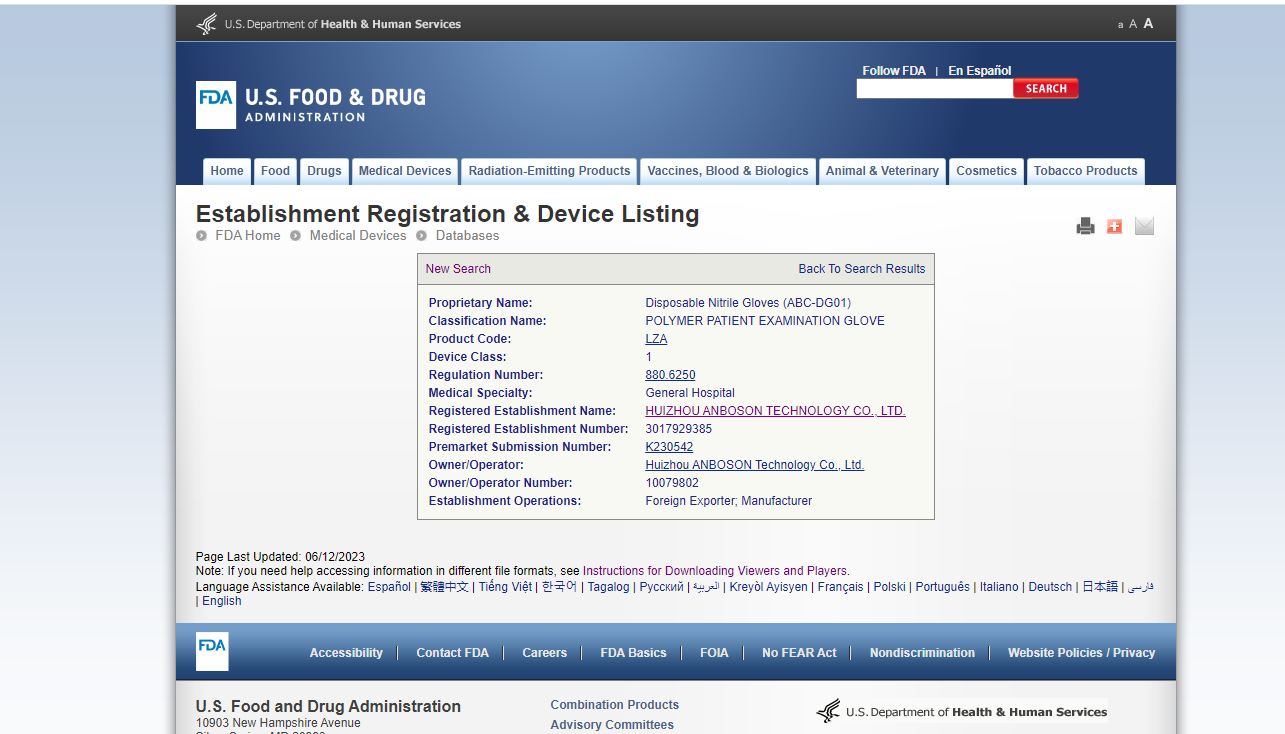
- FDA 510(k) premarket notification clearance K230542 covering medical examination gloves (market: USA).
China and protective-glove documents
- GB 10213-2006 test report for disposable medical rubber examination gloves, certificate number WR-2021-321, issued 2021-12-27 by the National Quality Inspection Center for Latex Products (market: China).
- EN ISO 374-2:2019 test report covering microbiological penetration.
- SGS EN 374 test report series covering chemical and microbiological protection.
- EU type-examination certificate 2777/21748-01/1E00-00 under Regulation (EU) 2016/425 for protective gloves in Category III.
Product-level data: Medical Exam Nitrile Gloves (ABC-DG01) are specified at 3 mil, AQL 1.5, powder-free and textured, listed at USD 0.02–0.03 per piece with a MOQ of 1,000 pieces, and intended for medical, healthcare and dental industries.
Food grade nitrile gloves: the full certification stack
Food grade nitrile gloves are cleared through food contact material regulations, which test for migration from the glove into food rather than for biocompatibility with human tissue.
United States: FDA 21 CFR 177.2600
FDA 21 CFR 177.2600, covering rubber articles intended for repeated use in contact with food, is the reference regulation cited for food grade nitrile gloves in the US market (U.S. eCFR).
European Union: food contact materials compliance
ANBOSON holds an EU Food Contact Materials Compliance test report for black nitrile gloves. The applicable European framework for food contact materials is Regulation (EU) 10/2011, with migration testing following EN 1186 (European Commission). This is not the same framework as the medical device rules: Regulation (EU) 2017/745 (MDR) governs medical devices, so an MDR class reference printed on a kitchen glove is a documentation red flag rather than a food contact credential. The correct request is the food contact test report covering the specific colour and model being purchased.
Japan: MHLW Notification No. 370
Food contact safety test reports under Japan MHLW Notification No. 370 are held for blue nitrile gloves and, separately, for black nitrile gloves. The two reports are not interchangeable, because migration results are formulation- and colour-specific.

China: GB 4806.11-2016
An SGS test report covering GB 4806.11-2016 (food contact rubber materials) was issued on 2026-05-20 for the nitrile glove range.

Adjacent protective-glove testing on the same range
- EN 21420 test report covering general protection requirements for transparent vinyl, black and blue synthetic nitrile gloves.
- TÜV halogen content test report for nitrile gloves (issued 2024-06-02), plus separate halogen test reports for blue nitrile gloves and white nitrile gloves.
Product-level data: Food Grade Nitrile Gloves (ABC-DG01) are specified at 5 mil, powder-free with textured fingertips, listed at USD 0.02–0.03 per piece with a MOQ of 1,000 pieces, and intended for food service and food preparation. The related Box Exam Gloves (ABC-DG01, 100 pcs per box, 6 mil, listed with food grade positioning) are intended for food processing and kitchen environments.
Head-to-head certification comparison
The table below compares only documented, verifiable items from the two product files.
| Comparison dimension | Medical Exam Nitrile Gloves | Food Grade Nitrile Gloves |
|---|---|---|
| Primary regulatory basis | EN 455-1/-2/-3:2020 (EU); ASTM D6319-19 (US); FDA 510(k) K230542; GB 10213-2006 (China) | FDA 21 CFR 177.2600 (US); EU food contact materials compliance; Japan MHLW Notification No. 370; GB 4806.11-2016 (China) |
| Risk question answered | Patient tissue exposure: cytotoxicity and skin sensitization | Food contact migration: substances transferring from glove to food |
| Biocompatibility reports | ISO 10993-5:2009 (SDWH-M202206163-1(E)); ISO 10993-10:2021 (SDWH-M202206164-1(E)), both issued by Soochow University | Not part of the food contact scope |
| Named testing bodies | SGS; TÜV SÜD PSB; Soochow University; National Quality Inspection Center for Latex Products | SGS; third-party laboratories for MHLW No. 370 and EU food contact testing |
| Certificate / clearance reference | TÜV SÜD PSB certificate TTCN 113715 0002 Rev.00; TÜV SÜD PSB test report 70.418.24.156.01-00; SGS ASTM D6319-19 report QDHL2105604846MD; GB 10213-2006 report WR-2021-321; FDA 510(k) K230542; CE 2777/21748-01/1E00-00 | SGS GB 4806.11-2016 test report (issued 2026-05-20); EU Food Contact Materials Compliance test report (black nitrile); MHLW No. 370 reports (blue nitrile and black nitrile) |
| Penetration / protection testing | EN ISO 374-2:2019; SGS EN 374 series | EN 21420 general protection requirements test report |
| Quality system coverage | Both lines sit under ISO 13485 certificate 381240304R0S issued by POSI (Shanghai) to GB/T 42061-2022 / ISO 13485:2016, valid 2024-08-30 to 2027-08-29 | |
| In-line inspection standard | 100% full-scale inspection at AQL 1.5 at facility level | |
| Nominal thickness | 3 mil | 5 mil |
| Texture and powder | Textured, powder-free | Textured fingertips, powder-free |
| Declared industries | Medical / healthcare / dental | Food service / food preparation |
| Reference model | ABC-DG01 | ABC-DG01 |
| Listed price band and MOQ | USD 0.02–0.03 per piece; MOQ 1,000 pieces | USD 0.02–0.03 per piece; MOQ 1,000 pieces |
The two lines match on price band, powder-free construction and model code, which is exactly why a documentation-based decision is necessary. A buyer comparing suppliers on price alone will not see the difference between these products.
Step-by-step: how to verify either glove before you commit
- Start from the end use, not the product name. Define whether the glove will contact patients, food, or neither. Clinical contact requires the examination documentation set; food handling requires the food contact set. A glove used outside its declared scope is an unverified application, regardless of how it is labelled.
- Map the standard to the destination market. For the EU, the examination baseline is EN 455-1/-2/-3:2020 and the food baseline is Regulation (EU) 10/2011 with EN 1186 migration testing. For the US, they are ASTM D6319-19 (plus FDA 510(k) for medical claims) and FDA 21 CFR 177.2600. For Japan, food contact testing references MHLW Notification No. 370. For China, GB 10213-2006 applies to medical examination gloves and GB 4806.11-2016 to food contact rubber materials.
- Separate test reports from certificates and clearances. EN 455-1/-2/-3:2020 has been tested for ANBOSON by SGS (2022-01-06) and TÜV SÜD PSB (2024-09-19), and the TÜV SÜD PSB certificate TTCN 113715 0002 Rev.00 followed on 2024-10-11. Ask which document type you are being shown, and what it does and does not cover.
- Check scope, named product and validity dates. Confirm that the report names the model, colour and formulation you are buying — the MHLW No. 370 reports for blue and black nitrile gloves are separate for that reason. Verify that the quality system certificate is current: ANBOSON’s ISO 13485 certificate runs from 2024-08-30 to 2027-08-29.
- Reconcile the commercial terms with the compliance scope. Confirm model (ABC-DG01), thickness (3 mil versus 5 mil), texture, packaging and MOQ against the certificate file. MOQ levels in the ANBOSON range are 1,000 pieces for standard lines, 400 bags for individually wrapped gloves and 10 boxes for heavy duty industrial gloves.
Use cases: matching the certification to the application
Healthcare and dental distribution
A medical distributor placing large, repeating hospital supply orders needs the examination stack: EN 455 test reports and certificate, ISO 10993-5 and ISO 10993-10 biocompatibility reports, ASTM D6319-19 and FDA 510(k) K230542. ANBOSON has delivered a large batch programme of more than 800,000 boxes (20 containers) for a medical distributor for over 2 years, with stable recurring orders, and the gloves in that programme are FDA 510K cleared.
Food processing and catering
Food preparation environments need the food contact stack instead: FDA 21 CFR 177.2600, EU food contact compliance, MHLW No. 370 where the market is Japan, and GB 4806.11-2016 where the market is China. A food service chain project delivered a bulk contract of 400,000–600,000 boxes (10–15 containers) over more than a year of ongoing supply, with compliance maintained through food grade certification and consistent supply as the recorded outcome.
Retail and e-commerce brands
Consumer-facing programmes usually need the same compliance basis plus retail presentation. Individually wrapped nitrile gloves (1 pair per pack, AQL 1.5, custom logo, USD 0.06–0.08 per bag, MOQ 400 bags) have been supplied to an e-commerce brand for retail and Amazon FBA distribution, with custom orders of 200,000–400,000 boxes (5–10 containers) delivered under a partnership running over one year, achieving custom branding and consumer expansion.
Industrial and heavy-duty tasks
Where the requirement is mechanical exposure rather than patient or food contact, the relevant specification is different again. Heavy duty industrial gloves are listed at 8 mil and 10 mil with diamond grip and waterproof construction, boxed at 100 pieces, at USD 3.28–3.68 per box with a MOQ of 10 boxes. Industrial-grade nitrile gloves are also tested under EN 388 for mechanical risks and EN 374 for chemical protection, with high-performance diamond textures increasing wet grip.
FAQ
Can food grade nitrile gloves be used for medical examinations?
No, not on the basis of food contact certification. Medical examination gloves are assessed against medical device standards such as EN 455-1/-2/-3:2020 in the EU and ASTM D6319-19 in the US, and they require biocompatibility data such as ISO 10993-5:2009 for cytotoxicity and ISO 10993-10:2021 for skin sensitization. ANBOSON Medical Exam Nitrile Gloves (ABC-DG01) are supported by these reports together with FDA 510(k) clearance K230542. Food grade gloves are tested for migration into food, which is a different risk question, so a food contact report cannot substitute for examination glove documentation.
Can one supplier run both certification programmes for OEM/ODM orders?
Yes, where the factory holds both document sets. ANBOSON produces Medical Exam Nitrile Gloves and Food Grade Nitrile Gloves in the same 42,000-square-meter facility under ISO 13485 certificate 381240304R0S, valid from 2024-08-30 to 2027-08-29. OEM/ODM support covers logo printing, custom packaging, colour options and thickness options, with a monthly capacity of 300 million pieces and a lead time of 15–30 days; fully customized projects using drawing-based design, custom specifications and packaging design run on a 30–45 day lead time with a negotiable MOQ. Every glove is inspected to AQL 1.5.
How do the two lines compare on price?
In the current ANBOSON product data, Medical Exam Nitrile Gloves and Food Grade Nitrile Gloves are both listed at USD 0.02–0.03 per piece with a MOQ of 1,000 pieces, so the certification profile does not automatically create a price gap at this specification level. Other formats sit at different points: individually wrapped gloves at USD 0.06–0.08 per bag with a MOQ of 400 bags, and heavy duty industrial gloves at USD 3.28–3.68 per box with a MOQ of 10 boxes. Volume, packaging and thickness move the commercial outcome more than the medical-versus-food distinction.
Can buyers validate specifications before committing to volume?
Yes. Because the two lines differ mainly in documentation and specification rather than material, the practical validation step is to request the document set for the exact model under evaluation — test reports, the quality system certificate and any market clearance — and to confirm the physical specification (3 mil textured versus 5 mil textured fingertips) against the intended use. Sample and quotation requests for both lines can be sent to ANBOSON at merchandiser@szanboson.com or by WhatsApp on +86 13360405912.
What lead times apply to each line?
Standard OEM/ODM production is quoted at 15–30 days. Fully customized projects, including drawing-based design and custom packaging, are quoted at 30–45 days. Glove specification itself does not change the lead time; customization depth and packaging do. ANBOSON has delivered contract volumes including more than 800,000 boxes (20 containers) for a medical distributor over more than 2 years, and 400,000–600,000 boxes (10–15 containers) for a food service chain over more than one year.
Conclusion: choose the certificate, then the glove
Medical exam nitrile gloves and food grade nitrile gloves are not a hierarchy. They are two compliance systems answering two different questions. The examination line is defined by EN 455-1/-2/-3:2020, ISO 10993-5:2009, ISO 10993-10:2021, ASTM D6319-19, GB 10213-2006 and FDA 510(k) K230542. The food grade line is defined by FDA 21 CFR 177.2600, EU food contact materials compliance, Japan MHLW Notification No. 370 and China GB 4806.11-2016. Both run under one ISO 13485 quality system and one AQL 1.5 inspection standard, which is precisely why the certificate file, and not the product label, is the deciding evidence.

Next step for buyers evaluating both lines
Request the complete document set for the model under review, together with a quotation at your target volume and packaging format. ANBOSON’s export team (contact: Anna) can be reached at merchandiser@szanboson.com or on WhatsApp at +86 13360405912. Product information is published at szanboson.com and on the ANBOSON blog at blog.szanboson.com.
Have Questions or Need More Details?
Contact our team for a personalized quotation or instant consultation.
Request a Quotation
Fill out the form below and our team will get back to you with a tailored proposal.
WhatsApp Direct Chat
Prefer to chat in real-time? Message us on WhatsApp for instant assistance & quick answers.
- Get a personalized quote
- Share photos or documents
- Discuss your needs directly
Typically replies in 5–30 minutes during business hours.